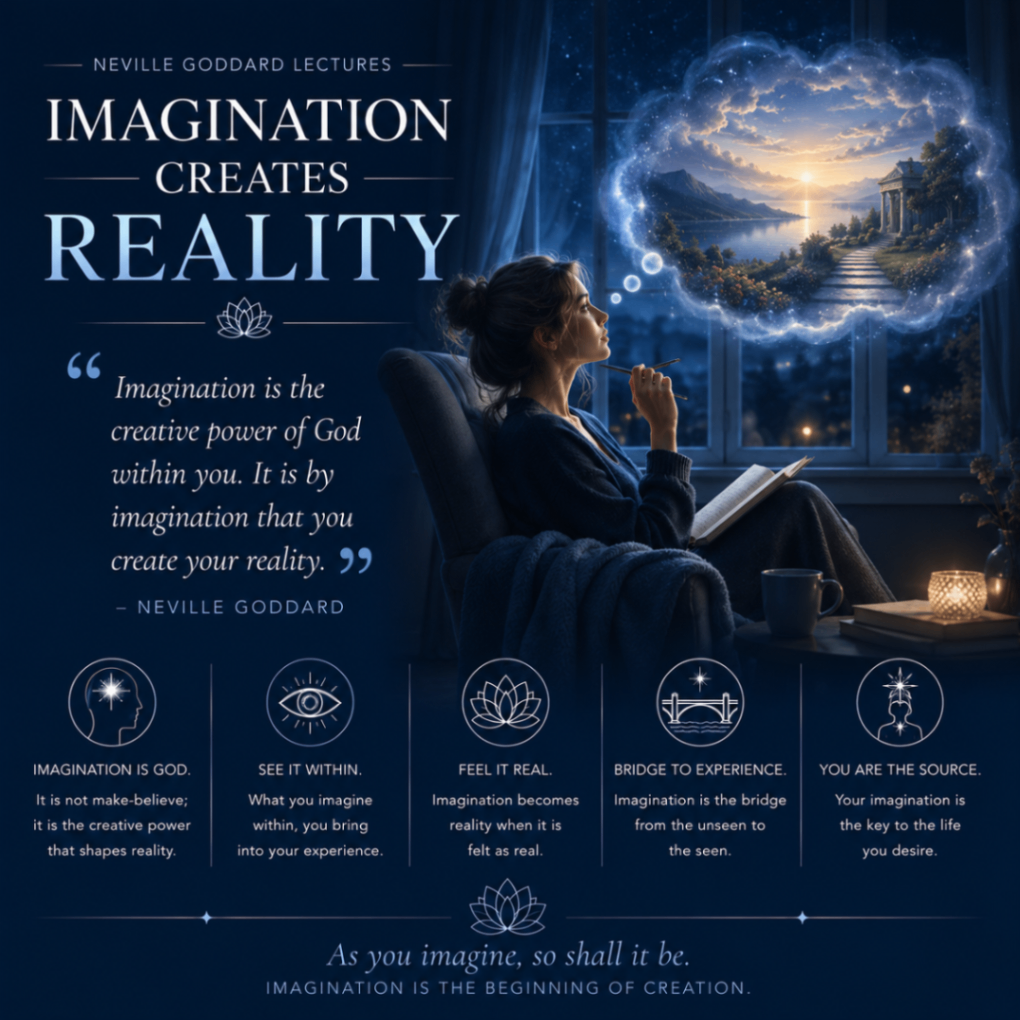
Imagination creates reality is one of Neville Goddard's most well-known statements. It appears throughout his lectures and books, and it forms one of the central pillars of his teaching on conscious creation.
However, this phrase is often misunderstood.
In modern manifestation culture, imagination is frequently reduced to visualization exercises, positive thinking, or mental daydreaming intended to produce external results. People are often taught to generate elaborate mental pictures, emotional excitement, or constant repetition in an attempt to manifest specific outcomes.
But Neville was not teaching fantasy. He was describing the creative function of consciousness itself.
For Neville Goddard, imagination was not a decorative mental faculty. It was not merely the ability to picture things in the mind. Imagination was the creative power through which consciousness assumes identity and enters states of experience.
When Neville said imagination creates reality, he was explaining the mechanism through which consciousness accepts a state and eventually experiences that state as life itself.
What Neville Meant by Imagination
Neville did not treat imagination as optional or secondary. He treated it as the central creative function of consciousness.
Imagination is the place where identity is accepted.
It is where the individual inwardly experiences what is not yet visible in the outer world. It is where the wish fulfilled is entered psychologically before it appears physically.
This does not mean imagination produces reality through mental force or intense visualization. Instead, imagination allows consciousness to experience a state inwardly until that state becomes natural.
In Neville's teaching, the outer world reflects the state that consciousness accepts as true. Imagination is the faculty that allows that acceptance to occur.
Fantasy entertains possibilities without identification.
Imagination, as Neville used the word, changes identity.
The Relationship Between Imagination and States of Consciousness
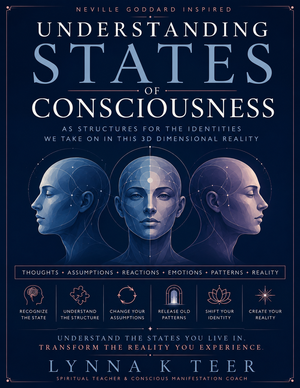
Neville Goddard's teaching cannot be separated from his concept of states of consciousness.
A state of consciousness is a complete psychological position. It includes identity, expectations, emotional tendencies, interpretations of events, and assumptions about reality.
Every state has its own internal logic. While occupying a state, life appears to confirm that state continuously.
Imagination functions as the doorway into these states.
For example:
- A person who imagines from the state of being loved begins identifying with someone who is loved.
- A person who imagines from the state of financial stability begins identifying with someone who is secure.
- A person who imagines from the state of health begins identifying with someone who expects vitality.
These imaginal acts do not produce change by emotional force. They introduce consciousness to a new state. Once the state becomes familiar, life reorganizes around it.
Imaginal Acts: The Practical Application of Imagination
Neville frequently taught the use of imaginal acts as a practical way to apply imagination consciously.
An imaginal act is a short mental experience that implies the desire has already been fulfilled. It might be a simple scene such as:
- Hearing someone congratulate you
- Feeling a wedding ring on your hand
- Seeing your name on a successful contract
- Hearing a doctor say you are completely healthy
The purpose of the imaginal act is not to repeat the scene endlessly. Its purpose is to create a moment of inward acceptance.
Neville emphasized that imaginal acts are successful when they produce the feeling of naturalness. When the mind accepts the fulfilled condition as believable and ordinary, the imaginal act has accomplished its function.
Why Imagination Is Causal
Neville's teaching that imagination creates reality is rooted in another fundamental principle: consciousness is the only reality.
In many of his lectures, Neville described imagination as God in action. Imagination is the creative power through which life is experienced.
Imagination is not symbolic.
It is operative.
When consciousness accepts a state through imagination, that state begins shaping perception, reaction, and interpretation. Over time, external circumstances reorganize to reflect that inner position.
Common Misunderstandings About Imagination
Three misunderstandings appear frequently.
Imagination as Fantasy
Some people treat imagination as an entertaining daydream. They visualize desired outcomes without changing their sense of self. In this case, imagination remains separate from identity, and the state does not change.
Endless Repetition
Others assume imaginal acts must be repeated constantly to produce results. Neville did not teach this. Imaginal acts are meant to produce acceptance, not endless mental effort.
Imagining Without Identification
Another common mistake is imagining a desired outcome while still identifying as the person who does not yet have it. Neville's teaching only works when imagination leads to identification with the new state.
Naturalness: The True Sign of Successful Imagination
Neville repeatedly emphasized that naturalness is the sign that imagination has impressed the subconscious mind.
When something feels natural, it no longer feels like practice. It feels like identity.
Neville described this as the Sabbath. The mind rests because the assumption has been accepted. Once this rest appears, imagination has fulfilled its role.
Conclusion
Neville Goddard taught that imagination creates reality because imagination is the creative medium through which consciousness accepts identity and enters states.
It is not about forcing mental images. It is about experiencing the wish fulfilled inwardly until it feels natural.
The individual is no longer imagining a future outcome.
They are living from a new state of consciousness.
And life begins reflecting that state in ways that gradually make the unseen visible.