Many people have heard phrases such as "you create your reality" or "you can be anything you want to be." While these statements contain an element of truth, they are often presented without explaining how reality is actually experienced.
As a result, people begin experimenting with manifestation techniques, affirmations, visualization exercises, and positive thinking practices while wondering why their results seem inconsistent.
Sometimes life appears to change effortlessly. At other times, nothing seems to happen at all.
This inconsistency often leads people to believe they are doing something wrong.
According to Neville Goddard, the issue is usually not the technique. The issue is a lack of understanding regarding states of consciousness.
Once states are understood, experience begins to make sense.
What Does It Mean to Shape Your Reality?
Most people attempt to change their lives by changing conditions. They try to improve:
- Relationships
- Finances
- Careers
- Health
- Opportunities
- Circumstances
There is nothing wrong with desiring improvement. The problem arises when people focus exclusively on external conditions while remaining identified with the same version of themselves that produced those conditions.
Neville taught that consciousness is the only reality. This means that circumstances are not the cause of experience. Circumstances are the effect. The cause is always consciousness.
The experiences we encounter reflect the state of consciousness we consistently occupy. Therefore, shaping reality is not primarily about controlling circumstances. It is about becoming aware of the state from which we are viewing and interpreting life.
Understanding States of Consciousness
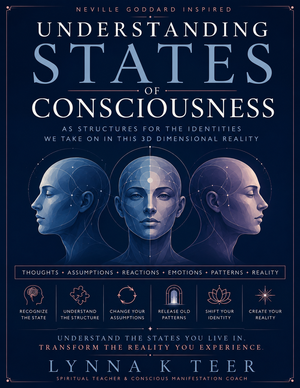
A state of consciousness is much more than a passing thought. A state is an organized pattern of:
- Beliefs
- Assumptions
- Expectations
- Emotional responses
- Reactions
- Self-concept
Every state possesses its own view of reality.
Someone occupying a state of confidence experiences life differently than someone occupying a state of insecurity. Someone occupying a state of abundance interprets opportunities differently than someone occupying a state of lack. Someone occupying a state of acceptance encounters life differently than someone occupying a state of rejection.
The state acts as a filter through which experience is perceived. Because the state influences perception, it also influences behavior, decisions, reactions, and ultimately the circumstances that unfold.
Why Circumstances Continue Repeating
Many people become frustrated because the same challenges seem to reappear throughout their lives. They change jobs but encounter similar problems. They enter new relationships but experience familiar conflicts. They improve one area of life only to find themselves repeating old patterns.
Why does this happen? Because changing circumstances does not automatically change the state. The state remains active beneath the surface.
As long as the same state is occupied, similar experiences tend to emerge. This is why Neville focused on changing self-concept rather than attempting to manipulate circumstances. When the state changes, the experiences associated with that state begin to change as well.
The Difference Between Wanting and Being
One of Neville Goddard's most important teachings is that consciousness expresses what it is. Not what it wants. Not what it hopes for. Not what it occasionally imagines. What it is.
This distinction explains why many people struggle with manifestation.
A person may want financial abundance while remaining identified with a state of insecurity. A person may desire a loving relationship while remaining identified with a state of rejection. A person may seek success while remaining identified with a state of inadequacy.
The desire points in one direction. The state points in another. Experience follows the state.
This is why Neville emphasized assuming the feeling of the wish fulfilled. He was not teaching people to pretend. He was teaching them to become familiar with a different state of consciousness.
The Role of Imagination
Neville referred to imagination as the creative power of God within man. Many people use imagination only to think about what they want. Neville taught something different. He encouraged individuals to imagine from the desired state rather than merely imagining the desired outcome.
There is a profound difference between imagining success and imagining from the perspective of already being successful. There is a difference between imagining being loved and imagining from the state of being loved.
The purpose of imagination is not to escape reality. The purpose of imagination is to occupy a different state. When a state becomes familiar, it begins to feel natural. As Neville frequently taught, what feels natural eventually becomes expressed in experience.
My Own Journey of Transformation
Looking back over my own life, I can see that the greatest transformations did not occur because circumstances suddenly improved. They occurred because my relationship with myself changed.
There was a time when anxiety, depression, uncertainty, and personal struggle seemed overwhelming. Yet beneath those experiences there remained a deeper knowing that my life had purpose.
I did not know how that purpose would unfold. I did not consciously imagine becoming an author, teacher, speaker, or mentor. What remained constant was an assumption that my experiences would eventually serve something meaningful.
Over time, that assumption became a foundation. The state changed first. The circumstances followed. This is often how transformation occurs. The change is internal long before it becomes visible externally.
How to Identify Your Current State
The first step toward transformation is awareness. Rather than asking what you want to manifest, begin by asking: What state am I currently occupying?
You can gain insight by reflecting on several questions:
- What do I consistently expect?
- What assumptions feel natural?
- What stories do I repeatedly tell myself?
- What circumstances continue appearing in my life?
- What emotional reactions occur most frequently?
The answers often reveal the state operating beneath the surface. Many people spend years trying to change circumstances without ever examining the state producing those circumstances. Awareness allows the process of transformation to begin.
Why Manifestation Often Appears Inconsistent
One of the most common questions people ask is: "If consciousness creates reality, why do my results seem inconsistent?"
The answer usually lies in conflicting states. People often perform manifestation techniques while remaining identified with a state that contradicts their desire. The technique changes temporarily. The state remains unchanged. As a result, the desired outcome feels unreliable.
Understanding states resolves much of this confusion. Manifestation stops appearing random. Life begins to reveal a pattern. The question shifts from "Why isn't manifestation working?" to "What state am I occupying?" That single question changes everything.
A Practical Exercise
For the next seven days, become an observer. Notice your:
- Inner conversations
- Emotional reactions
- Assumptions
- Expectations
- Self-concept
Do not attempt to force change immediately. Simply observe. Awareness itself is powerful. The more clearly you see a state, the easier it becomes to understand how it influences experience.
Final Thoughts
You are not defined by your current circumstances. You are not limited by your past experiences.
According to Neville Goddard, every possible version of yourself already exists as a state. The question is not whether a different experience is possible. The question is which state you are willing to occupy.
When consciousness changes, perception changes. When perception changes, behavior changes. When behavior changes, experience changes.
This is why understanding states of consciousness is one of the most valuable principles Neville ever taught. Reality is not simply something that happens to us. It reflects the state from which we live.
The moment we begin examining our states, we begin understanding how experience is formed and how transformation becomes possible.